Custom Kitchen Cabinets vs. Stock Cabinets: A Homeowner’s Guide
Construction, materials, pricing, and long-term value compared
If you are planning a kitchen renovation in Ontario, one of the biggest decisions you will face is whether to go with custom kitchen cabinets or stock cabinets. It is a question that affects everything — the look of your kitchen, how well the space functions, how long the cabinets last, and ultimately, how much you spend.
There is no universally right answer. But there is a right answer for your home, your kitchen, and your budget. This guide breaks down the real differences between custom and stock cabinetry so you can make an informed decision.
What You Will Learn
- How custom and stock cabinets differ in construction, materials, and fit
- Where each option makes sense (and where it does not)
- Realistic pricing for both options in Ontario
- Why custom cabinetry Durham Region homeowners choose often pays for itself over time
What Are Stock Cabinets?
Stock cabinets are pre-manufactured in standard sizes and sold off the shelf — or ordered from a catalogue with a short lead time. They are available at big-box retailers and many kitchen dealers across the GTA.
Typical characteristics:
- Standard dimensions: Widths in 3-inch increments (12″, 15″, 18″, etc.), fixed heights and depths
- Materials: Particleboard or MDF box construction with a melamine or thermofoil finish; some mid-range lines use plywood boxes
- Hardware: Basic hinges and drawer slides, often proprietary to the manufacturer
- Finish options: Limited selection of colours and door styles from the manufacturer’s current line
- Lead time: Days to a few weeks
Stock cabinets serve a purpose. For a rental property, a quick flip, or a tight budget where function matters more than fit, they can be a reasonable choice.
What Are Custom Kitchen Cabinets?
Custom cabinets are built to order for your specific kitchen. Every box, drawer, and door is made to the exact dimensions of your space, with the materials, hardware, and finish you choose.
Typical characteristics:
- Built to your dimensions: No filler strips, no awkward gaps, no wasted space
- Materials: Solid hardwood frames and doors (maple, oak, cherry, birch), plywood box construction
- Hardware: Soft-close hinges and full-extension drawer slides as standard; premium options available
- Finish options: Unlimited — any paint colour, stain, glaze, or combination
- Lead time: 6 to 12 weeks depending on the shop and complexity
Custom cabinetry is what you find in homes where the kitchen was designed around how the homeowner actually cooks, stores, and lives — rather than designed around what sizes happen to be available.
Construction: Where the Difference Really Shows
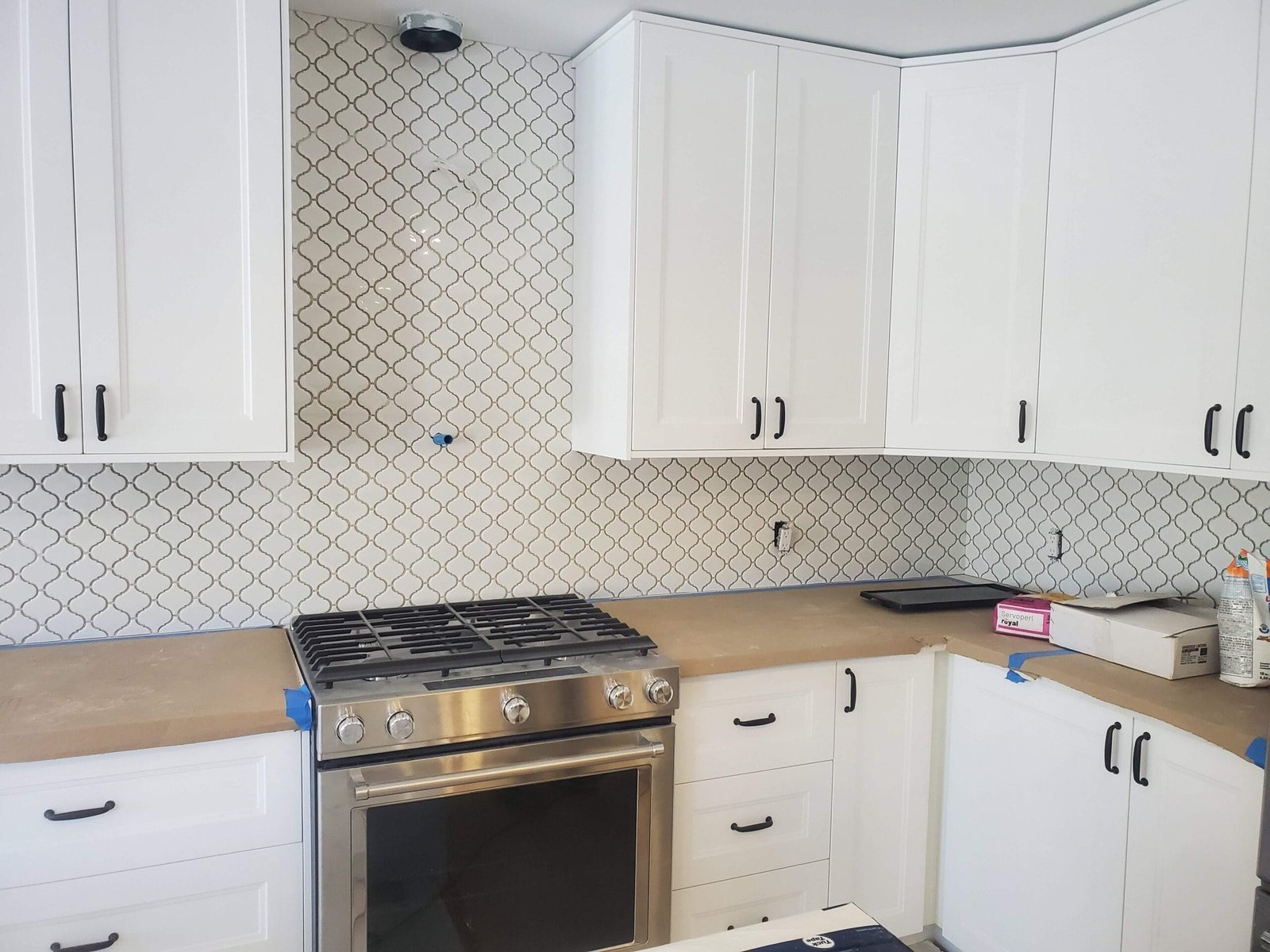
This is the area most homeowners underestimate. From the outside, a stock cabinet and a custom cabinet can look similar. Inside, they are fundamentally different.
Box Construction
Stock cabinets typically use particleboard or thin MDF for the box (the carcass). Particleboard is made from wood chips and resin pressed together. It is inexpensive, but it does not hold screws well over time, swells when exposed to moisture, and sags under heavy loads.
Custom cabinets use 3/4-inch plywood for the box. Plywood is stronger, lighter, holds fasteners reliably, and resists moisture far better than particleboard. It is the reason custom cabinets feel solid when you open and close them — and still feel solid 20 years later.
Joinery
Stock cabinet boxes are typically held together with staples, cam locks, or dowels. Custom cabinets are assembled using dado joints, glue, and mechanical fasteners — a combination that creates a rigid, durable box that does not rack or loosen.
Shelving
Stock shelves are often 5/8-inch particleboard that bows under the weight of dishes and pantry goods. Custom shelves are typically 3/4-inch plywood, and in many cases, solid hardwood edging is applied to the front for additional stiffness and a clean look.
Drawer Construction
This is one of the most telling differences. Stock drawers are usually stapled MDF or thin plywood. Custom drawers are dovetailed hardwood — a joint that has been used in fine woodworking for centuries because it is nearly impossible to pull apart.
Materials and Finishes: Durability You Can See and Feel
Door and Drawer Fronts
Stock cabinets often use thermofoil (a vinyl film heat-wrapped over MDF) or rigid thermofoil (RTF). These finishes can peel, especially near heat sources like ovens and dishwashers. They cannot be repaired — only replaced.
Custom cabinet doors are typically solid hardwood or a hardwood frame with a veneered centre panel. Painted custom doors use high-quality conversion varnish or catalyzed lacquer finishes that are far more durable and repairable than thermofoil.
Interior Finish
Open a stock cabinet and you will usually see raw particleboard or a thin melamine coating. Open a custom cabinet and you will see finished plywood — sanded, sealed, and easy to clean.
Fit and Function: Making Every Inch Count
Ontario kitchens, especially in older Whitby, Brooklin, and Oshawa homes, are rarely perfectly square. Walls are not plumb. Corners are not 90 degrees. Floors are not level. Stock cabinets in standard sizes cannot accommodate these realities — you end up with filler strips, gaps, and compromises.
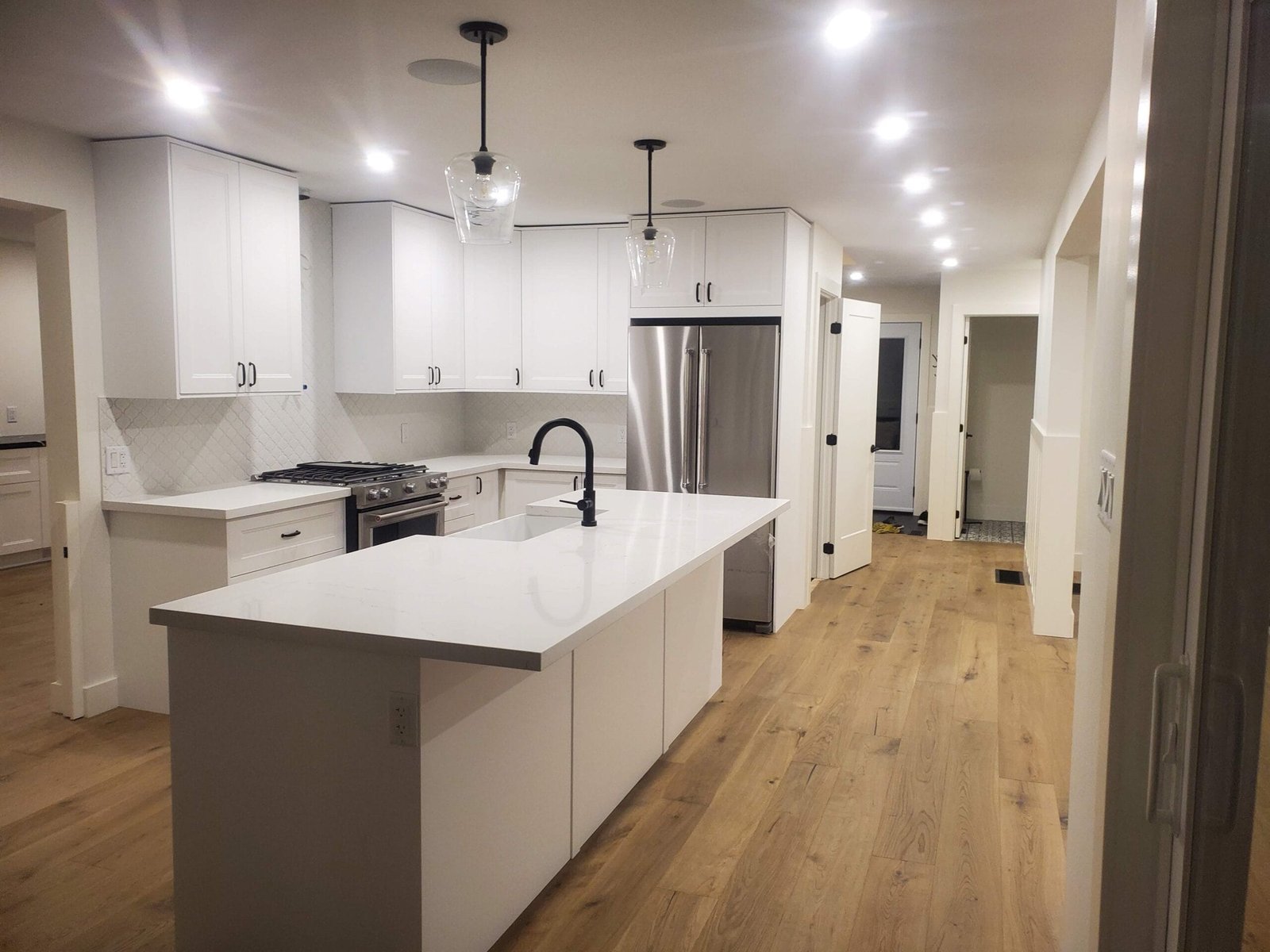
Custom cabinets are measured and built for your actual kitchen. That means:
- No wasted space. Cabinets extend fully into corners and up to the ceiling if you want them to.
- Optimized storage. Drawer widths, shelf heights, and interior accessories are designed for how you use your kitchen.
- Unique layouts. Angled walls, odd corners, soffits, and bulkheads are all accounted for in the design.
- Integrated details. Crown moulding, light valances, decorative panels, and end caps are built in — not applied as afterthoughts.
For homeowners in Durham Region who are investing in a kitchen renovation they plan to live with for 15 or 20 years, custom fit is not a luxury. It is practical.
Pricing: What to Expect in Ontario (2026)
Kitchen cabinet pricing varies widely based on layout, material choices, and scope. These are general ranges for a typical 10-by-12-foot kitchen in the Durham Region and GTA:
| Cabinet Type | Price Range (Installed) | What You Get |
|---|---|---|
| Stock (basic) | $5,000 — $10,000 | Particleboard boxes, thermofoil doors, basic hardware |
| Stock (mid-range) | $10,000 — $18,000 | Plywood boxes, wood or HDF doors, upgraded hardware |
| Semi-custom | $18,000 — $30,000 | Some size flexibility, better materials, more finish options |
| Fully custom | $30,000 — $55,000+ | Built to your specs, hardwood construction, premium everything |
The gap between mid-range stock and fully custom is real — but so is the gap in quality, longevity, and daily satisfaction. Custom cabinets in a well-maintained kitchen routinely last 25 to 30 years or more. Stock cabinets often show significant wear in 10 to 15 years.
Long-Term Value: The Math Most People Miss
It is tempting to look at the upfront price and choose stock. But consider the full picture:
Replacement cycle. Stock cabinets that wear out in 12 to 15 years cost you twice over a 30-year period. (The same principle applies to trim work and other finishing details.) Custom cabinets built properly may never need replacing.
Resale impact. Real estate agents in Durham Region consistently identify kitchen quality as one of the top factors in buyer decisions. CMHC research backs this up — kitchen renovations consistently rank among the highest-return home improvements. Custom cabinetry is immediately recognizable and adds real value.
Daily experience. Soft-close drawers that glide smoothly, doors that hang perfectly, shelves that do not sag — these are things you experience every single day. The difference in quality of life is not abstract.
Which Option Is Right for You?
Stock cabinets may be the right choice if you are renovating a rental property, working within a strict budget, or planning to sell within a few years and need the kitchen to look presentable.
Custom cabinets are worth the investment if you are renovating your forever home (or close to it), you want your kitchen to work exactly the way you need it to, and you value craftsmanship and durability.
For many homeowners across Whitby, Brooklin, Oshawa, and the wider Durham Region, the answer lands somewhere in the middle — and that is where a conversation with an experienced cabinetmaker makes all the difference.
Ready to Explore Custom Cabinetry for Your Kitchen?
I have over 20 years of experience in custom finishing carpentry across Durham Region, including kitchen cabinetry built and installed to exacting standards. Whether you’re starting from scratch on a new build or replacing worn-out stock cabinets in an existing home, I can walk through your space, discuss your options, and provide a clear, honest quote.
Get in touch today for a free kitchen cabinetry consultation.
Leave a Reply