How Much Do Custom Kitchen Cabinets Cost in Ontario?
2026 pricing guide for Durham Region homeowners
Quick answer: Custom kitchen cabinets in Ontario typically cost $25,000 to $60,000 installed for a standard 10-by-12-foot kitchen (2026, CAD). In Durham Region — Whitby, Brooklin, Oshawa, and Clarington — most homeowners land between $30,000 and $45,000 for mid-range custom cabinetry in solid plywood with painted maple doors. Price is driven mainly by wood species, door profile, finish type, and total linear footage.
If you are researching custom kitchen cabinet cost in Ontario, you have probably already discovered that getting a straight answer is not easy. Quotes vary wildly, and most of what you find online is either American pricing in US dollars or so vague it is not helpful.
I have been building and installing custom kitchen cabinets across Durham Region and the GTA for over 20 years — in Whitby and Brooklin renovations, Oshawa new builds, and Clarington homes throughout Bowmanville and Courtice. Below, I will break down what custom cabinetry actually costs in Ontario in 2026, in Canadian dollars, so you can plan your renovation with real local numbers.
What You Will Learn
- Realistic 2026 pricing for custom kitchen cabinets in Ontario (in CAD)
- What homeowners in Durham Region typically pay, by kitchen size
- How material and finish choices affect your total cost
- What drives the price difference between a $25,000 and a $55,000 kitchen
- Why Ontario pricing differs from the American figures you find online
Custom Kitchen Cabinet Pricing in Ontario (2026)
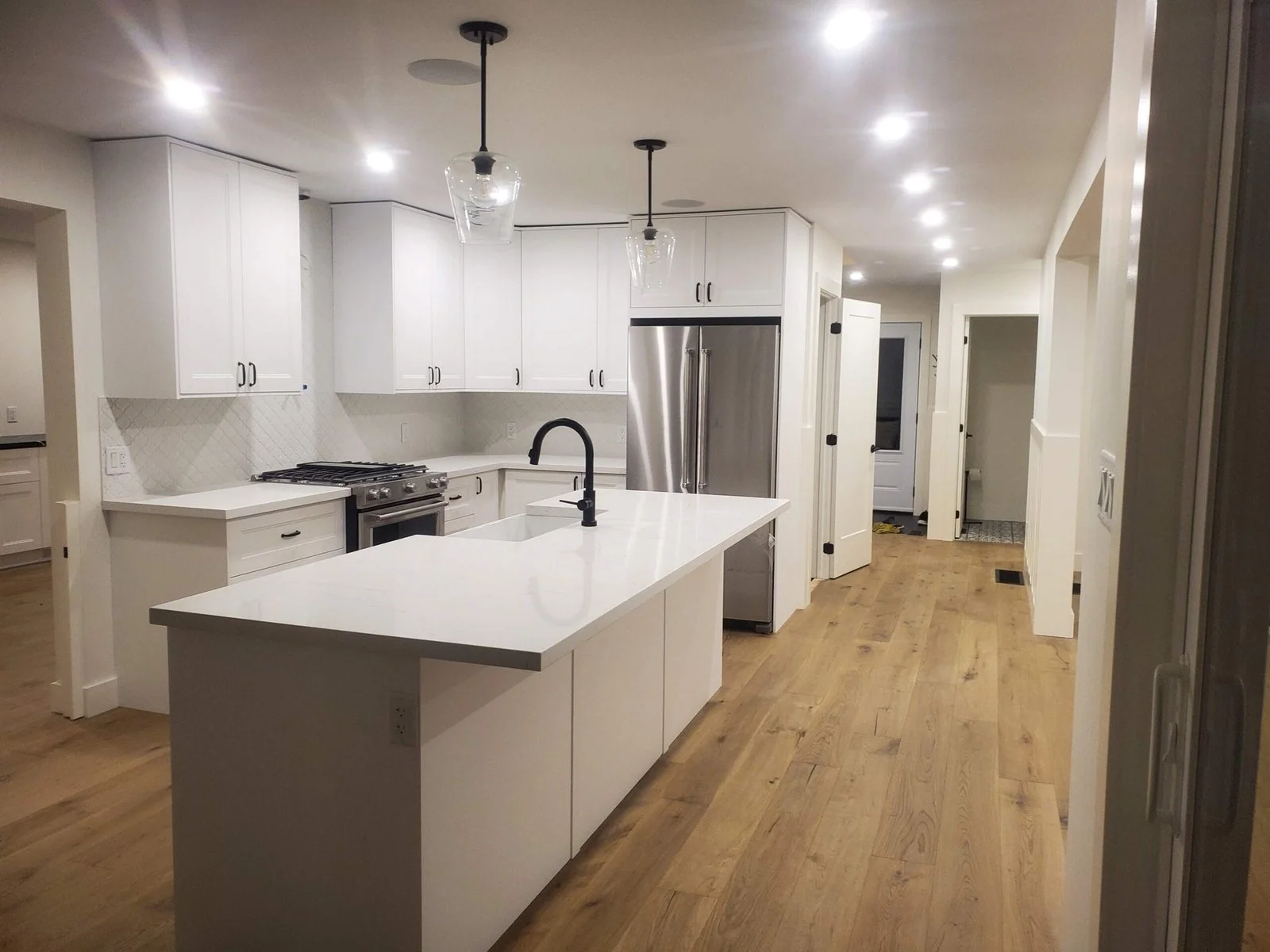
The following ranges reflect fully installed custom cabinetry — materials, building, finishing, and professional installation — for a typical 10-by-12-foot kitchen in the Durham Region and GTA.
| Scope | Price Range (Installed) | What Is Included |
|---|---|---|
| Basic custom (simple layout) | $25,000 — $35,000 | Plywood boxes, maple or birch doors, painted finish, soft-close hardware |
| Mid-range custom | $35,000 — $45,000 | Plywood boxes, upgraded wood species, custom stain or two-tone finish, specialty storage |
| High-end custom | $45,000 — $60,000+ | Premium hardwoods, complex door profiles, built-in organizers, integrated lighting, decorative details |
These are general ranges. Your actual cost depends on your kitchen layout, material selections, and the level of detail you want. A galley kitchen with 15 linear feet of cabinetry will land on the lower end. A large L-shaped or U-shaped kitchen with an island, pantry tower, and full upper cabinets to the ceiling will land higher.
What Affects Custom Kitchen Cabinet Cost in Ontario?
1. Material Selection
Material choice is one of the biggest cost drivers. Here is how common options compare:
| Material | Relative Cost | Notes |
|---|---|---|
| Paint-grade maple or birch | $$ | The most popular choice for painted kitchens — smooth grain, takes paint beautifully |
| Red oak | $$ | Classic look, prominent grain, excellent durability |
| White oak (rift or quarter-sawn) | $$$ | Clean, modern grain pattern — very popular right now |
| Cherry | $$$ | Rich colour that deepens over time, elegant appearance |
| Walnut | $$$$ | Premium dark wood, striking grain, top of the price range |
For box construction, 3/4-inch plywood is the standard for quality custom cabinets. I use plywood for every cabinet box I build — it is stronger, lighter, and more moisture-resistant than particleboard. That is non-negotiable.
2. Door Style and Profile
A simple shaker door is less expensive to produce than a raised-panel door with detailed edge profiles. Flat-slab (modern) doors fall somewhere in between depending on the material.
Common door styles and their cost impact:
| Door Style | Cost Impact |
|---|---|
| Flat slab (modern) | Low to moderate |
| Shaker (recessed panel) | Moderate — the most popular style in Ontario right now |
| Raised panel (traditional) | Moderate to high |
| Beaded inset | High — requires extremely precise fitting |
| Custom profile or applied moulding | High — more machining and finishing time |
3. Finish Type
Finish is where many homeowners are surprised by the cost. A high-quality finish is labour-intensive and directly affects how the cabinets look and hold up.
| Finish | Relative Cost | Notes |
|---|---|---|
| Painted (single colour) | $$ | Requires primer, multiple coats, sanding between coats, and clear topcoat |
| Stained and lacquered | $$ — $$$ | Highlights the natural wood grain; darker stains require more coats |
| Two-tone (e.g., island in a different colour) | $$$ | Essentially two separate finishing setups |
| Glazed or distressed | $$$ — $$$$ | Hand-applied detail work on top of the base finish |
| Raw or matte lacquer (natural look) | $$ | Simpler process, but the wood must be flawless |
I spray all my finishes with catalyzed conversion varnish — it is harder, more chemical-resistant, and more durable than what you get from a brush-on polyurethane or a factory thermofoil wrap.
4. Cabinet Accessories and Interior Features
The interior of your cabinets is where custom really separates from stock. Common upgrades and their approximate costs:
| Feature | Approximate Cost (Per Unit) |
|---|---|
| Soft-close hinges and drawer slides | Included as standard |
| Pull-out waste/recycling bins | $300 — $600 |
| Pull-out spice rack or tray dividers | $250 — $500 |
| Lazy Susan (corner cabinet) | $400 — $700 |
| Deep drawer peg system (dish storage) | $150 — $300 |
| Integrated under-cabinet lighting | $500 — $1,500 (depending on scope) |
| Custom range hood surround | $1,500 — $4,000 |
| Pantry tower with pull-out shelves | $2,500 — $5,000 |
These features add cost, but they are the reason people choose custom — your kitchen works the way you actually use it, not the way a factory decided it should.
5. Kitchen Layout and Scope
More cabinetry means more cost, but not in a purely linear way. Larger projects are more efficient per linear foot because of material ordering, shop setup, and installation logistics.
| Kitchen Size | Typical Custom Cabinet Budget |
|---|---|
| Small (galley or single wall, 10–15 linear ft) | $20,000 — $30,000 |
| Medium (L-shaped, 15–25 linear ft) | $30,000 — $45,000 |
| Large (U-shaped or L + island, 25–35 linear ft) | $40,000 — $55,000 |
| Large with pantry, hutch, or butler’s pantry | $50,000 — $70,000+ |
What Custom Cabinets Cost in Whitby, Oshawa, and Clarington
Cabinet pricing does not change dramatically from one Durham Region municipality to the next — my rates are the same whether I am working in Brooklin or Bowmanville. What does change is the kind of kitchen I am working in, and that affects the final number.
Whitby and Brooklin. A mix of established homes and newer subdivisions. Older Whitby kitchens often need extra scribing and fitting because walls are out of plumb, which adds installation time. Newer Brooklin builds are usually square and straightforward, but homeowners here tend to upgrade — pantry towers, islands, and taller uppers push budgets toward the $40,000 to $50,000 range.
Oshawa. Strong demand for kitchen renovations in older north-end and downtown homes. These projects frequently involve reworking an awkward original layout, and custom cabinetry is what makes an odd footprint usable. Typical range: $30,000 to $45,000.
Clarington — Bowmanville, Courtice, and Newcastle. Lots of new construction, and many homeowners are replacing builder-grade cabinets within a few years of closing. Because the layouts are modern and the spaces are open, these projects often centre on a large island and a walk-in pantry. Typical range: $35,000 to $55,000.
A note on GTA pricing. Quotes from downtown Toronto shops often run 15 to 25 percent higher than Durham Region for comparable work, largely due to overhead and travel. Being based in Brooklin means I am not carrying that cost, and I am not passing it on.
Why Custom Cabinets Cost More — and Why It Matters
The price gap between custom and stock cabinets is real. But it is important to understand what you are paying for:
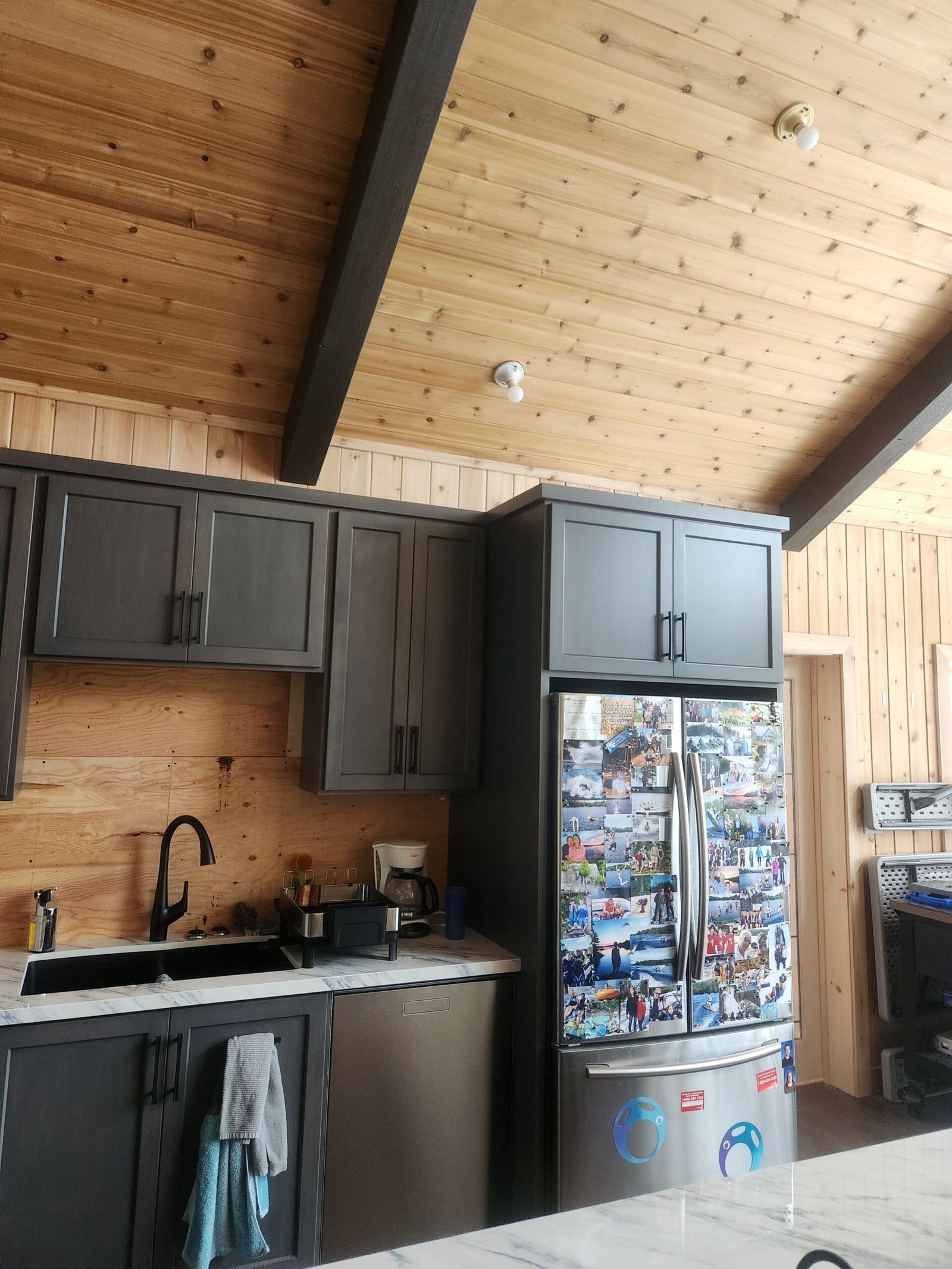
Precision fit. Every cabinet is built to your kitchen’s actual dimensions. No filler strips, no gaps, no dead space. In older Whitby and Brooklin homes where walls are rarely plumb and corners are rarely square, this matters enormously.
Material quality. Plywood boxes, hardwood doors and drawer fronts, dovetailed drawer boxes, full-extension soft-close slides. These are not upgrades — they are the baseline for custom work.
Longevity. I build cabinets that last 25 to 30 years or more. Stock cabinets with particleboard boxes and thermofoil doors typically show serious wear in 10 to 15 years. When you factor in a replacement cycle, custom cabinets are often the more economical choice over the life of your home.
Daily satisfaction. Drawers that glide smoothly, doors that close silently, storage that makes sense for your life — these are things you experience every morning when you make coffee and every evening when you cook dinner.
How to Get an Accurate Cabinet Quote in Durham Region
Online pricing guides (including this one) are useful for ballpark planning, but every kitchen is different. The best way to get an accurate number is straightforward:
- Walk-through. I visit your kitchen, take measurements, and discuss what you want — layout, style, materials, and any must-haves.
- Design and quote. I put together a detailed quote that breaks down materials, labour, hardware, finishing, and installation. No hidden costs.
- Review together. We go through it line by line. If the total needs to come down, I can show you exactly where adjustments can be made without compromising quality.
Custom Kitchen Cabinet Cost in Ontario: Common Questions
Are custom kitchen cabinets worth it in Ontario? For most Durham Region homeowners, yes — provided you plan to stay in the home more than a few years. Custom cabinetry lasts 25 to 30 years against roughly 10 to 15 for particleboard stock units, and it uses every inch of an awkward or older kitchen. If you are renovating to sell within a year, semi-custom is usually the better financial call.
How much do custom kitchen cabinets cost per linear foot in Ontario? Expect roughly $1,200 to $2,200 per linear foot installed in 2026, in Canadian dollars. Painted maple shaker at the lower end; walnut or beaded inset with specialty storage at the upper end.
Why are the prices I find online so much lower? Most online cabinet pricing is American, quoted in US dollars, and often refers to stock or semi-custom lines rather than true custom work. Once you convert currency and account for Ontario labour and material costs, those figures stop being comparable.
How long do custom kitchen cabinets take to build in Durham Region? Typically 8 to 12 weeks from approved design to installation, depending on finish complexity and my current schedule. Booking in advance matters, especially heading into fall and the pre-holiday stretch.
Do you serve all of Durham Region? Yes. I work throughout Whitby, Brooklin, Oshawa, Ajax, Pickering, and Clarington, including Bowmanville, Courtice, and Newcastle, from my base in Brooklin.
Ready to Price Out Your Kitchen?
I have built custom kitchens for homeowners across Durham Region — from full-scale renovations in Whitby and Brooklin to new builds in Oshawa and across the GTA. If you are serious about custom cabinetry and want a clear, honest number to work with, I would be happy to walk through your space and put together a detailed quote.
Contact Dixon Custom Carpentry today for a free kitchen cabinetry consultation.
Leave a Reply